Cangzhou Rongzeng Metal Materials Sales Co., Ltd.


From Glass to Hardware—Every Part of a Soundproof Window Is Packed with Technology
A truly high-quality soundproof window is a systematic engineering project in which every component has been meticulously designed. Womusen’s product documentation reveals the comprehensive technical design of its soundproof windows, from the glass to the hardware.
I. Automotive-Grade Tempered Glass: Combining Safety and Sound Insulation
According to the documentation, Womusen uses automotive-grade tempered glass, which is characterized by high strength, impact resistance, and superior sound insulation. Automotive-grade 3C tempered glass not only offers higher strength but also allows for wider aluminum spacers and a greater volume of molecular sieve filling. The interior is filled with the inert gas argon, ensuring superior sound insulation, thermal insulation, and energy efficiency. When glass thicknesses are comparable, sound insulation performance primarily depends on the acoustic barrier capability of the PVB laminate layer.
II. Low-E Insulated Glass: The “Invisible Master” of Thermal Insulation
According to the data, the use of thermal break aluminum profiles and Low-E insulated glass can improve thermal insulation by approximately 40%. Low-E glass is coated with a metallic film that offers high transmittance of visible light while reflecting a high percentage of infrared radiation. It reflects more of the infrared and ultraviolet rays from sunlight, while reflecting indoor heat back into the room during winter, keeping interiors warm in winter and cool in summer, resulting in significant energy savings.
III. Thermal Break Aluminum Profiles: The “Skeleton” of the Multi-Chamber Structure
During the process of balancing indoor and outdoor temperature differences, 37% of heat exchange occurs through windows. Thermal break aluminum profiles use PA66 nylon thermal break strips to separate the inner and outer aluminum alloys, thereby eliminating thermal bridges. Combined with a multi-chamber structural design, this approach structurally blocks heat conduction. Profile wall thickness is also critical—the national standard requires exterior window profiles to have a wall thickness of ≥1.8 mm. The thicker the wall, the greater the resistance to vibration and the lower the sound transmission.
IV. Customized Silent Hardware System: The “Joints” Tested for 60,000 Openings and Closings
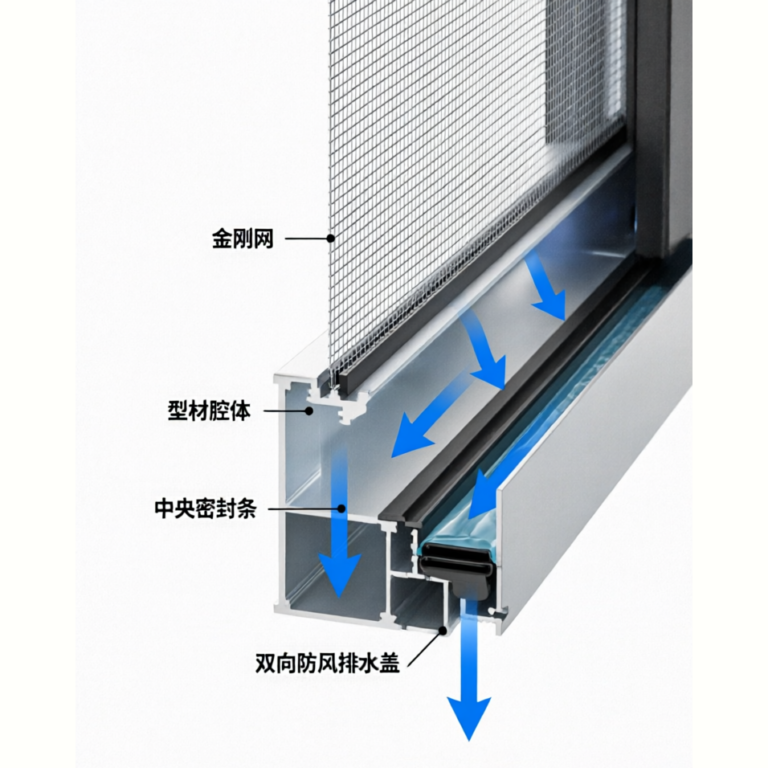
Hardware serves as the “joints” of doors and windows, directly affecting the opening and closing experience as well as the sealing performance. Womusen employs a custom silent hardware system that has undergone over 60,000 opening and closing cycles, ensuring robust structural strength and durability. This high-performance hardware system delivers superior performance, security against break-ins, and smooth, effortless operation. In high-end window systems, drainage channels are physically isolated from the hardware transmission paths, ensuring a tight seal while preventing water accumulation from corroding the hardware and extending its service life.
V. Overall Window Performance: More Than Just Sound Insulation
From glass to profiles, from fillers to hardware, from drainage to sealing—the precise coordination of every component ultimately results in a window that delivers exceptional thermal insulation performance under various climatic conditions, comprehensively enhancing the building’s comfort in terms of temperature, acoustics, aesthetics, and health.
A silent window is not the result of a single component “going it alone,” but rather the outcome of the entire system working in unison.